2026 Agenda
Agenda as of February 9. Check back soon for more updates!
Sunday, Mar 22
-
3:00 pm — 5:00 pm
Exhibitor Move-in
Expo Hall -
5:00 pm — 7:00 pm
Check-in and Registration
Grand Hall -
5:30 pm — 6:30 pm
Happy Hour for First Time Attendees
WT Partnership PavilionCalling all first-time attendees! Join us for this exclusive networking reception where you can meet and mingle with fellow first-time attendees. The P3C Media team will be available to answer any questions, and ensure you feel comfortable and connected. Enjoy light refreshments and engaging conversations as we welcome you to your first P3 conference!
Monday, March 23
-
8:00 am — 5:30 pm
Check-in and Registration
Grand Hall -
7:30 am — 8:45 am
The Owner’s Table: A Public Sector Breakfast Forum
The Owner’s Table is a public sector–only breakfast forum that kicks off the P3 Conference & Expo with direct, peer-level conversation among public owners.
The forum opens with a moderated Q&A featuring public sector leaders, shaped by questions submitted in advance and from the room. The discussion is candid and practical, grounded in real project experience and the realities of delivering complex infrastructure projects.
-
8:00 am — 9:00 am
Networking Breakfast
Expo HallAll conference delegates are welcome to join us in the Expo Hall for a networking breakfast.
-
9:00 am — 10:00 am
Workshop 1: The Public Official’s Masterclass: Next-Gen Tools for Infrastructure Finance & Delivery
Part 1: The New Standard for P3 Evaluation
This session provides a deep dive into the BAC’s Value for Money (VfM) Analysis Principles and Standards, offering attendees a practical understanding of the new standardized methodology. Participants will be guided through the VfM Checklist and apply it to a sample project case study, working step-by-step to assess whether the project meets the “Value for Money” test. Designed to be interactive and hands-on, this session equips attendees with the tools and confidence to apply VfM principles consistently and effectively in real-world project evaluations.
This workshop is open to all registered attendees.
-
9:00 am — 10:00 am
Workshop 2
-
9:00 am — 10:00 am
Workshop 3
-
10:00 am — 10:30 am
Networking Break
Expo Hall -
10:30 am — 11:30 am
Workshop 1: The Public Official’s Masterclass: Next-Gen Tools for Infrastructure Finance & Delivery
Part 2: Funding Strategy with GrantsPlus
Part 2 of this session focuses on funding strategy and navigating the complex federal grant landscape using modern technology. Attendees will be introduced to GrantsPlus through a live demonstration and interactive discussion. Participants will see how entering key project parameters can instantly generate a tailored matrix of eligible federal grant opportunities and innovative financing mechanisms applicable to local projects. This session is designed to help public agencies and project teams identify funding options more efficiently and make informed decisions that advance project delivery.
This workshop is open to all registered attendees.
-
10:30 am — 11:30 am
Workshop 2
-
10:30 am — 11:30 am
Workshop 3
-
11:30 am — 12:30 pm
Workshop 1: The Public Official’s Masterclass: Next-Gen Tools for Infrastructure Finance & Delivery
Part 3: The Untapped Potential of Opportunity Zones
Part 3 explores the untapped potential of Opportunity Zones as a financing tool for public infrastructure projects beyond traditional real estate development. This session provides an overview of the legal frameworks and financial modeling considerations for deploying Opportunity Zone funds in projects such as transit hubs, broadband expansion, and utility upgrades. Attendees will also learn strategies for positioning and pitching infrastructure projects to Qualified Opportunity Funds, gaining practical insight into how OZ capital can be leveraged to support community-serving investments.
This workshop is open to all registered attendees.
-
11:30 am — 12:30 pm
Workshop 2
-
11:30 am — 12:30 pm
Workshop 3
-
12:30 pm — 1:45 pm
The P3 Exchange Lunch: Trends, Policies, and Projections for Success
Dallas BCA collaborative lunch discussion examining the evolving landscape of public-private partnerships—open to public sector attendees and hosted with support from conference sponsors.
-
2:00 pm — 3:00 pm
Roundtables - Part 1
-
3:00 pm — 3:30 pm
Networking Break
Expo Hall -
3:30 pm — 4:30 pm
Roundtables Part 2
-
4:30 pm — 5:30 pm
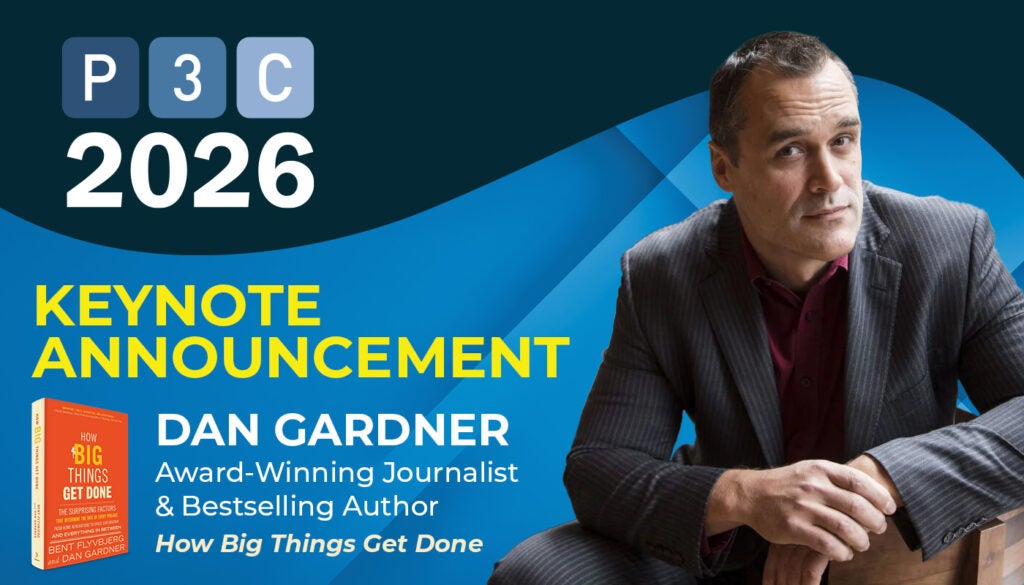
Opening Keynote: Dan Gardner, Award-Winning Journalist & Bestselling Author "How Big Things Get Done"
Dallas BC -
5:30 pm — 6:30 pm
Opening Night Welcome Reception
Expo HallJoin us at this special networking event for all conference delegates.


Tuesday, March 24
-
7:00 am — 5:30 pm
Check-in and Registration
Grand Hall -
8:00 am — 9:00 am
Networking Breakfast
Expo HallAll conference delegates are welcome to join us in the Expo Hall for a networking breakfast.
-
8:30 am — 8:45 am
Welcome from Conference Organizers
Dallas BC -
8:45 am — 9:30 am
State of the P3 Market: Trends, Innovation, and What’s Next
Dallas BCIndustry leaders share candid insights on the evolving state of the public-private partnership market and what lies ahead across sectors. This session will examine the strength and composition of today’s P3 pipeline, highlighting where deal activity is accelerating and how projects are being structured to meet shifting public and private priorities.
-
9:30 am — 10:15 am
Opening Plenary
Dallas BC -
10:15 am — 10:40 am
Networking Break
Expo Hall -
10:40 am — 11:05 am
Owner Insights - Will Reid, Commissioner, Tennessee Department of Transportation
Dallas BCThe first in a series of exclusive fireside chats offering direct insights from project owners. These conversations will shed light on their major projects, the difficulties they navigate, important lessons learned, and their vision for what lies ahead.
-
11:10 am — 11:55 am
From Projects to Programs: Building a Sustainable P3 Pipeline
Dallas BCSustainable P3 pipelines are intentionally built, not opportunistic. This session explores how public agencies move beyond one-off projects by developing the internal capacity, policies, and institutional knowledge needed to sustain a P3 program. Using contrasting approaches—from land-based development strategies and bundled delivery programs to bespoke, market-informed project identification—the discussion highlights how agencies embed P3s into day-to-day decision-making.
Attendees will gain practical insight into how agencies identify the right projects, align internal stakeholders, maintain transparency and accountability, build market confidence, and create a repeatable pipeline that delivers value for money and supports long-term infrastructure goals.
-
11:55 am — 12:15 pm
Owner Insights - Stephen Brich, Commissioner of Highways, Virginia Department of Transportation
Dallas BCOwner Insights is an exclusive fireside chat offering direct insights from project owners. These conversations will shed light on their major projects, the difficulties they navigate, important lessons learned, and their vision for what lies ahead.
-
12:15 pm — 12:35 pm
Owner Insights
Dallas BCOwner Insights is an exclusive fireside chat offering direct insights from project owners. These conversations will shed light on their major projects, the difficulties they navigate, important lessons learned, and their vision for what lies ahead.
-
12:35 pm — 2:10 pm
Networking Lunch
Expo HallStay tuned for additional lunch workshops!
-
2:15 pm — 3:00 pm
Concurrent Sessions
-
3:10 pm — 4:00 pm
Concurrent Sessions
-
4:00 pm — 4:30 pm
Networking Break
Expo Hall -
4:30 pm — 5:30 pm
Concurrent Sessions
-
5:30 pm — 6:30 pm
Networking Reception
Join us at this special networking event for all conference delegates.
Wednesday, March 25
-
7:00 am — 12:45 pm
Check-In & Registration
Grand Hall -
7:45 am — 8:45 am
Networking Breakfast
Expo HallAll conference delegates are welcome to join us in the Expo Hall for a networking breakfast.
-
8:45 am — 9:15 am
Morning Keynote: Jim Ross, Mayor, City of Arlington
Dallas BCWe kick off the final day with opening remarks from Jim Ross, the Mayor of the City of Arlington.
Presenter:Jim Ross, Mayor, Arlington, TX -
9:15 am — 10:00 am
From Rural Parish to Global Platform: Data Centers and the Next Frontier of Public-Private Possibility
Dallas BCAs demand for digital infrastructure accelerates, communities are being challenged to rethink how—and where—major projects can happen. This session examines how Richland Parish emerged as the host community for a landmark hyperscale data center investment, anchored by Meta, and what this moment reveals about the evolving role of public-private collaboration.
While large-scale data centers are not being delivered through traditional design-build-finance-operate-maintain P3 structures, the Richland Parish experience highlights a different kind of opportunity: how coordination among local and state governments, utilities, and the private sector can unlock projects of extraordinary scale and speed—particularly in rural and high-potential regions.
Using the Richland Parish data center campus as a case study, this discussion explores how public entities can position themselves as credible, competitive partners for capital-intensive technology projects, leverage infrastructure investments as long-term economic catalysts, and build frameworks that extend value well beyond construction. The session invites attendees to think expansively about what “partnership” can mean in the next era of P3s—and where new possibilities are beginning to take shape.
-
10:00 am — 10:45 am
From Today’s Deals to Tomorrow’s Models: Rethinking Data Center Project Delivery
Dallas BCThis session builds on the Richland Parish discussion by stepping back from the case study to examine the broader questions it raises for public-sector leaders. While today’s data centers are largely delivered as private projects, their scale, energy demands, and long-term community impacts are prompting new conversations about how these assets fit into public infrastructure strategies.
Rather than revisiting how individual deals are structured, this forward-looking discussion focuses on how project delivery models could evolve over time. Panelists will explore the conditions under which government entities might take on a more direct role in owning, overseeing, or delivering data center assets through a P3 model, and what that shift would mean for energy strategy, risk allocation, procurement approaches, and public accountability.
-
10:45 am — 11:15 am
Networking Break
Expo Hall -
11:15 am — 12:00 pm
A New Public-Private Model for Digital Infrastructure: How Open, Interoperable Base Maps Accelerate Project Delivery
Dallas BCGovernment agencies make high-stakes decisions every day—about safety investments, road expansions, permitting, resilience, and long-term capital planning. Yet these decisions often rely on fragmented, inconsistent, or outdated geospatial data. At the same time, private sector companies are building rich, highly accurate open map data to support their services in mobility, logistics, local sea.
Founded by AWS, Meta, Microsoft, and TomTom, Overture builds open, high-quality, interoperable base map data that anyone can use. By harmonizing inputs from public and private contributors, standardizing schema, and providing a common reference system (GERS), Overture enables agencies, vendors, and researchers to work from the same trusted foundation, reducing duplication and unlocking data interoperability.
This panel will showcase how municipalities are already leveraging Overture’s data for emergency response, transportation planning, economic development, and permit management. We’ll highlight Fresno County’s implementation, show how GERS ensures reliability across sources, and outline practical frameworks for integrating this continuously updated resource into government workflows.
-
12:00 pm — 12:45 pm
Closing Plenary
Dallas BC -
12:45 pm
Conference Ends & Exhibitor Breakdown